Leading tobacco control experts have described a Daily Mail article claiming that vapes have a “devastating health impact” on young people as “misleading by design”.
Experts say the paper behind the headline does not show causation, excludes benefits by design, and relies heavily on low-quality evidence.
The study, published in Tobacco Control, is an umbrella review of reviews – an analysis of existing systematic reviews rather than new research. Led by the University of York and the London School of Hygiene and Tropical Medicine, it aggregated 56 reviews of youth vaping and reported associations with later smoking, asthma, coughing, injuries, and some mental health outcomes.
Excludes evidence of benefits
Crucially, the review deliberately excluded any evidence on vaping benefits, including smoking cessation and adult data. Riccardo Polosa, a leading respiratory physician and harm reduction expert, told Clearing the Air this guaranteed a one-sided outcome.
“Because the methods explicitly exclude reviews on cigarette quitting and positive benefits, the evidence base is deliberately one-sided toward harms” he argued. “Media reports that generalise from this to overall risk-benefit are therefore misleading by design.”
Weak evidence dressed up as proof
Despite headlines suggesting vaping ‘causes’ smoking, asthma, depression, and more, the umbrella review does not prove causation. Most included reviews were graded low or critically low quality, with around 95 per cent relying on cross-sectional surveys that cannot establish cause and effect.
“The paper shows consistent associations (not proof of causation) between youth vaping and later smoking, substance use, asthma, coughing, injuries, and some mental health outcomes. Most included reviews rely on cross-sectional evidence and about 95 per cent are of low or critically low quality”, Polosa added.
The authors themselves stress it is difficult to “infer causality” and call for further longitudinal research.
Gateway claims questioned
The Daily Mail highlighted vaping as a gateway to smoking. While the review reported odds ratios suggesting vapers are more likely to try cigarettes later, Polosa cautions this does not prove causation.
“For smoking initiation, pooled odds ratios cluster around three, but the causal interpretation is contested and alternative explanations, such as common liability and risk propensity, remain plausible,” he said.
Cardiology expert Konstantinos Farsalinos added: “This is a repetition of the gateway to smoking theory, which has been largely rejected by real data. In the U.S., during the period of growing popularity of e-cigarettes, smoking rates have plummeted to the point that smoking has disappeared among U.S. youth.
“These studies simply show that adolescents who use e-cigarettes are more liable to engage into risky behaviors, therefore they are more likely to also smoke. This is the common liability model of behaviors, which is by far more realistic and valid compared to the ‘gateway’ theory.
“Below is a graph of smoking rates in the U.S., with data from the US CDC (Centers for Disease Control and Prevention). 2019 to 2020 was the peak of e-cigarette use among youth; in the following years youth vaping has significantly decreased.”
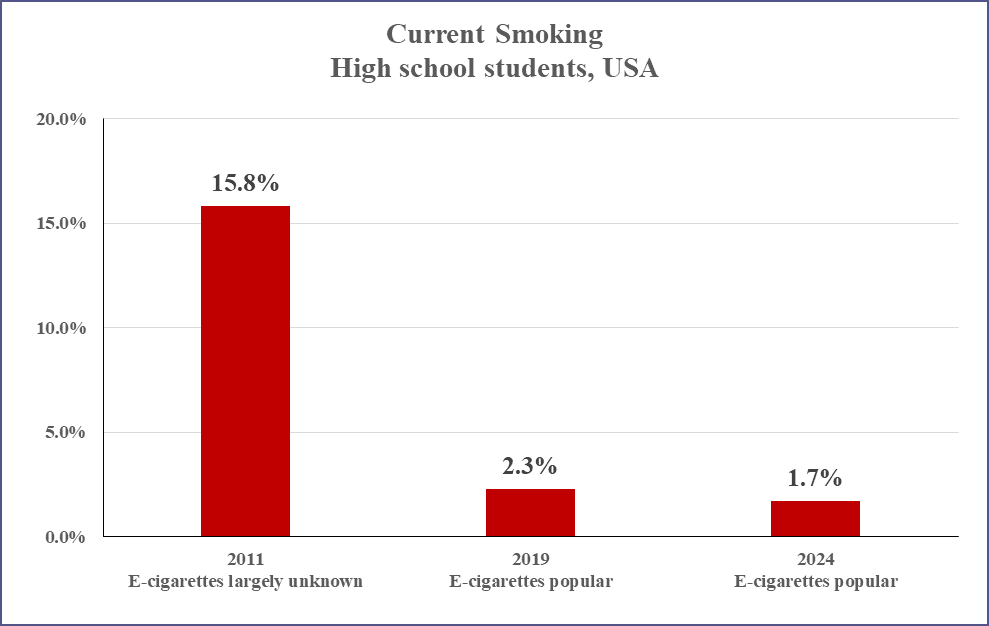
Source: Centers for Disease Control and Prevention
The statistics show that youth smoking rates have fallen sharply as vaping has become more common, countering the gateway narrative at a population level.
Respiratory concerns overstated
The paper’s asthma data was small, uncertain, and heavily reliant on self reporting. Pooled odds ratios ranged from 1.20 to 1.44 – effects Polosa described as “susceptible to misclassification, reverse causation, and unmeasured exposures such as secondhand smoke or allergens.”
Prof Peter Hajek, Professor of Clinical Psychology and Director of the Health and Lifestyle Research Unit at Queen Mary University of London (QMUL), added: “Some of these associations have well-known explanations. People with mental health issues are more likely to be attracted to psychoactive substances, and the same people who try one are also likely to try others. The link of vaping to asthma is more concerning but it requires further corroboration.
“The relevant studies included adults with smoking history, not never-smoking youth, and were previously criticised because the link could have been due to smoking rather than vaping, especially as smokers were included who had asthma before switching to vaping.”
EVALI misrepresented
The review also included case reports of exploding devices and the 2019 U.S. outbreak of EVALI, which was linked to illicit THC cartridges contaminated with vitamin E acetate, not commercial nicotine e-liquids.
Polosa said: “Injuries and ‘EVALI’ are not generalisable to nicotine vaping. Injuries are largely case reports of exploding devices. EVALI clusters were predominantly THC/vitamin-E acetate-related, not commercial nicotine e-liquids.”
What the evidence really shows
The authors recommend precautionary measures to restrict youth vaping and call for stronger longitudinal studies. Polosa agrees with keeping vapes away from children but stresses that findings cannot be generalised to adult harm reduction.
He said: “This umbrella review shows associations, often from lower-quality, overlapping, and cross-sectional evidence. It doesn’t assess benefits, so it cannot support net-harm claims.
“Reasonable policy conclusion: keep vapes away from kids, but don’t over-generalise to adult harm-reduction policy from this harms-only review.”
Misleading by design
Despite these caveats, the Daily Mail presented the findings as definitive proof that vaping causes multiple harms. Experts warn such coverage misleads the public and risks undermining policies that help smokers switch to safer alternatives.