


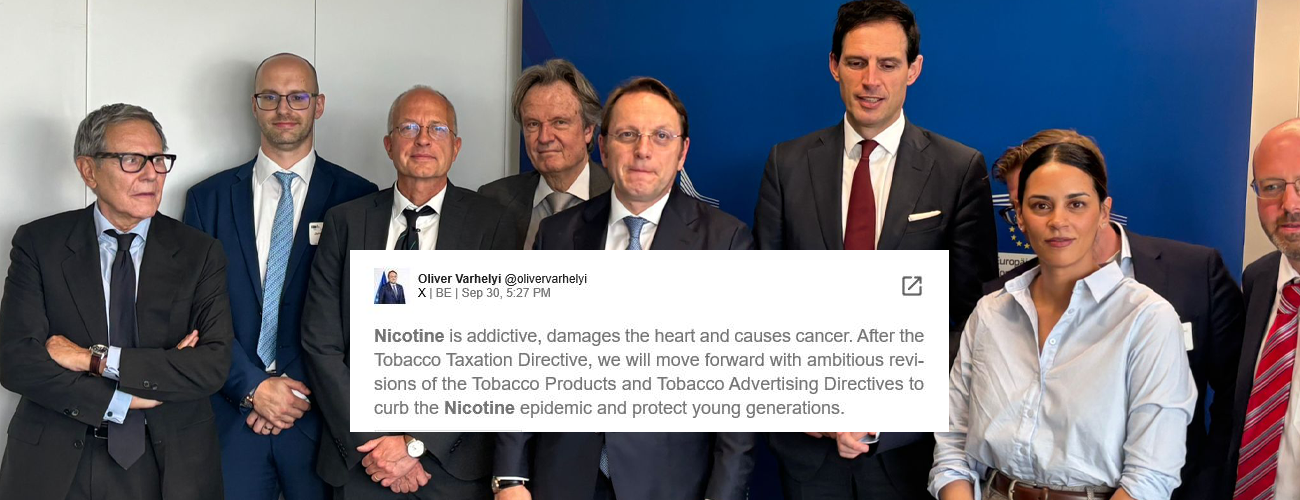

A European Commissioner has come under fire for spreading misinformation about nicotine, just months after another senior EU official made similarly inaccurate claims about vaping.
On September 30, Olivér Várhelyi, the Hungarian Commissioner responsible for health and animal welfare, wrote on X (formerly Twitter) that “Nicotine…causes cancer.”
It is accepted scientific fact that nicotine does not cause cancer according to Cancer Research UK. Even the European Commission in its most recent scientific report on electronic cigarettes concludes that “nicotine is not considered a human carcinogen”
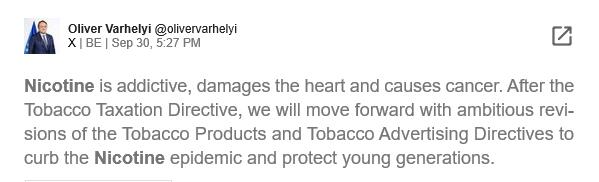
Várhelyi later edited his claim
The tweet was later edited to soften the language, replacing the phrase “causes cancer” with “contributes to cancer development.” But experts and campaigners say the correction still misrepresents the science.
Nicotine is addictive, but extensive research shows it is not carcinogenic. According to Professor Reuven Zimlichman, Director of the Institute for Quality in Medicine at the Israeli Medical Association, nicotine “does not cause cancer or heart disease.”
Instead, it is the thousands of toxic chemicals released through the burning of tobacco that are responsible for the eight million global deaths caused by smoking every year.
“Nicotine is addictive, but it doesn’t harm the body,” Zimlichman said at a recent medical convention. “It’s not carcinogenic, and it doesn’t cause heart disease. If there is an alternative way to satisfy the nicotine craving of smokers without burning tobacco, this is clearly an option worth considering.”
Harm reduction advocates push back
Várhelyi’s post drew criticism on social media. Dutch harm reduction group ACVODA accused the Commissioner of misleading the public to justify taxation plans. “There we go again, a tweet devoid of anything based on scientific knowledge. He just needs to convince the public that these things are true to justify his proposal,” wrote @plopnl.
Pouchforum.eu also challenged the Commissioner’s claim. It wrote: “Today’s remark that nicotine contributes to cancer contradicts scientific consensus. According to @US_FDA, @WHO, @RCPhysicians & @PHE_uk, nicotine is not a carcinogen. Public health depends on accuracy, not alarmism.”
Jukka Kelovuori, a Finnish former smoker, argued that such statements are reckless. “What he means is that they’ll cripple the safer nicotine alternatives to cigarettes and keep the EU smoking at a staggering average rate of 24%. I wouldn’t call it ambitious. I’d call it reckless and a menace to public health.”
Pattern of misinformation
This is not the first time Várhelyi has been accused of misrepresenting science around tobacco harm reduction. In an earlier post, he claimed that new nicotine and tobacco products posed health risks “comparable to traditional ones.” That statement was swiftly hit with a community note on X, clarifying that scientific evidence shows the opposite.
“New tobacco/nicotine products are comparable to nicotine replacement therapy, not smoking,” the note read, linking to multiple peer-reviewed studies and official government reports showing that vapers have substantially lower exposures to harmful chemicals, often at levels comparable to non-users.
It follows a similar episode earlier this year when Wopke Hoekstra, the Netherlands’ Commissioner for Climate Action told parliament in February that “vaping kills.”
While smoking kills 700,000 Europeans annually, there is no evidence to support Hoekstra’s claim that vaping has caused comparable harm.
Hoekstra’s assertion was also contradicted by the EU’s own evidence base. The European Parliament’s report on novel nicotine products confirms that vapes are far less harmful than smoking, with toxic emissions reduced by 90 to 95 per cent.
Sweden shows an alternative path
Evidence from Sweden demonstrates the importance of distinguishing between nicotine and smoking. Despite similar rates of nicotine use to other European countries, Sweden reports a 41 per cent lower incidence of lung cancer and the lowest tobacco-related death rate in the EU. This is attributed to widespread use of smoke-free products such as snus, nicotine pouches and vapes.
Advocates argue that the EU should learn from Sweden’s success and embrace tobacco harm reduction strategies instead of spreading misinformation. “Governments, regulatory agencies, and the medical community need to be open to new ideas such as tobacco harm reduction,” said Zimlichman.

