Youth vaping in the United States continued to decline in 2025, while smoking among teenagers remained close to historic lows, according to new analysis of the National Youth Tobacco Survey (NYTS).
The data shows that overall tobacco and nicotine product use among middle and high school students has fallen sharply compared with previous years, continuing a longer-term downward trend.
The summary states that it “highlights changes in youth tobacco and nicotine use trends over time, with particular emphasis on e-vapor products and nicotine pouches.”
Cigarette smoking now extremely rare
Cigarette use among US teenagers is now at very low levels.
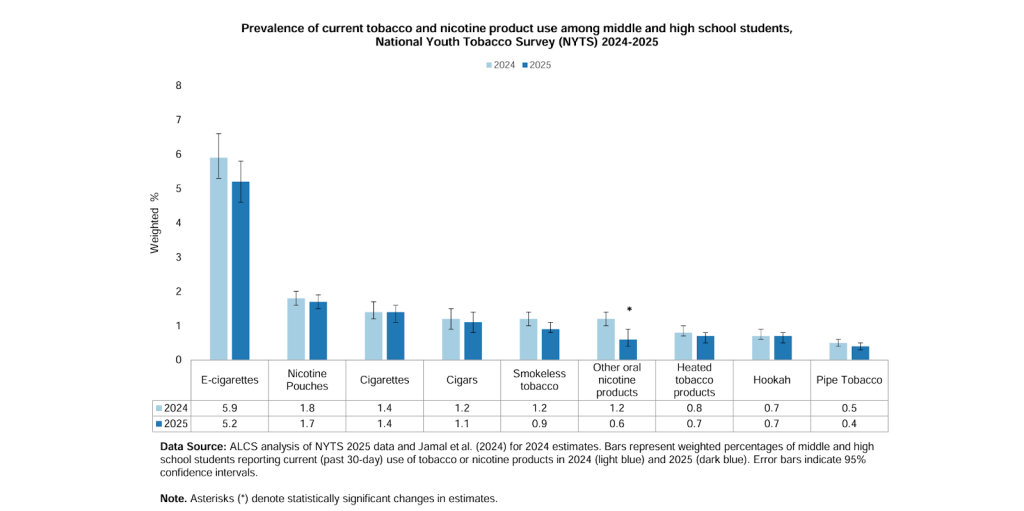
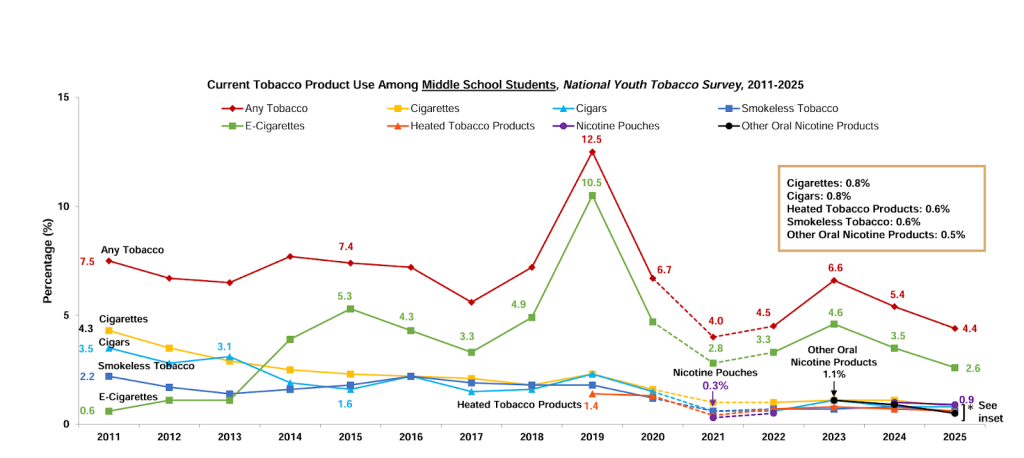
Among middle and high school students combined, just 1.4 per cent reported smoking cigarettes in 2025, according to the analysis. Among high school students alone, the figure was 1.8 per cent, while among middle school students it was 0.8 per cent.
These figures are dramatically lower than in the early 2010s, when cigarette smoking among teenagers was far more common.
The longer-term NYTS trend charts show cigarette use falling steadily over the past decade as other nicotine products emerged.
Vaping continues downward trend
Vaping remains the most commonly used nicotine product among US teenagers, but use has fallen again. In 2025, 5.2 per cent of middle and high school students reported using vapes in the past 30 days, down from 5.9 per cent in 2024.
Among high school students specifically, 7.1 per cent reported vaping, compared with 2.6 per cent of middle school students. The survey defines “current use” as use in the past 30 days.
Source: ALCS analysis of NYTS 2025
Overall youth tobacco use falling
Across all nicotine and tobacco products combined, 7.5 per cent of middle and high school students reported current use of any tobacco product in 2025.
This includes vaping, cigarettes, cigars, nicotine pouches, smokeless tobacco and heated tobacco products.
The long-term NYTS trend data shows youth tobacco use peaking in 2019, when 23.3 per cent of middle and high school students reported using any tobacco product, largely driven by vaping. Since then, overall use has fallen substantially.
Source: ALCS analysis of NYTS 2025
Nicotine pouch use remains low
Nicotine pouches – a relatively new category of smoke-free nicotine products – were used by 1.7 per cent of middle and high school students in 2025.
Usage rates were 2.3 per cent among high school students and 0.9 per cent among middle school students. The report notes that pouch use changed only slightly from the previous year.
Disposable vapes dominate the market
Among teenagers who do vape, disposable devices are by far the most commonly used.
The analysis found 66.3 per cent reported disposables as the device type they use most often, compared with 12.0 per cent using pods or cartridges and 5.4 per cent using tanks or mod systems.
A significant share of users said they did not know the device type they used.
Most youth vape occasionally
The survey also looked at how frequently teenagers reported vaping. Among current vape users:
- 42.4 per cent used vapes on 1-5 days in the past month
- 16.5 per cent used them on 6-19 days
- 41.2 per cent used them on 20-30 days
About 27.5 per cent reported daily use.
Fruit and sweet flavours remain most popular
Flavoured products remain widely used among teenagers who vape.
Among current youth vape users, the most common flavour categories were:
- Fruit – 59.3 per cent
- Candy, desserts or sweets – 31.7 per cent
- Mint – 29.5 per cent
- Menthol – 15.5 per cent
Other flavour categories included drinks, chocolate, spice and tobacco.
Mint leads nicotine pouch flavours
Among teenagers who reported using nicotine pouches, mint flavours were the most common.
The survey found 59.6 per cent used mint-flavoured pouches, followed by fruit (24.3 per cent) and menthol (18.1 per cent).
Youth nicotine use changing
Overall, the NYTS data show a major shift in youth nicotine use patterns over the past decade.
Traditional cigarette smoking has fallen to extremely low levels, while newer products such as vapes and nicotine pouches have become more common — though youth vaping itself has been declining in recent years.
The analysis notes that the summary is designed to “provide a high-level view of the data rather than a comprehensive assessment.”
The figures are based on analysis of the publicly released 2025 National Youth Tobacco Survey dataset by Altria Client Services. The official CDC/FDA analysis of the 2025 NYTS data has not yet been published.