


The European Commission appears to have found a new tactic when it comes to responding to the views of people who respond to their consultations with opinions they don’t like: call them fake and ignore them.
Politico reported this morning that David Boublil from the Commission’s tax department told an NGO-led seminar on the evils of nicotine that “We have been looking at the submissions in the public consultation and we saw some elements that indicated, indeed, some of the submissions were probably submitted in a coordinated manner and not necessarily representing individual views”.
This all seems to have started a few months back. Some outfit I had never heard of – Impact Unfiltered – seems to have sold a story about a study they did in response to the EU consultation on the Tobacco Tax Directive to Politico. They claim – and Politico uncritically repeated at the time – that most of the responses to that consultation shouldn’t be considered because they are somehow tainted by Big Tobacco.
After the Commission’s statement the other day, Impact Unfiltered’s Co-Founder, Joachim Verheyen, called for the Commission to “disregard the consultation results” if it thinks there has been tobacco industry interference, which is a pretty astonishing statement when you think about it. An NGO doesn’t want the Commission to take into account the views of the public. Fortunately, we’ve been looking into Impact Unfiltered, and their claims, for a few months now.
A word of background
I’ve been working on harm reduction issues for a long time and I’d never heard of Impact Unfiltered before. Their website doesn’t help much. They don’t seem to have a legal entity (or at least it’s not mentioned anywhere) distinct from the School of Moral Ambition, which I’ll come to. They seem to have been given some money by two Dutch Foundations. They say that their “policy recommendations rest on comprehensive research and data analysis of EU tobacco-control gaps”, but no such research appears on their website.
From what I can ascertain, they are an offshoot of the “School of Moral Ambition”, which sends “fellows” to work with anti-nicotine organisations in the hope of turning them into crusaders for the cause. They’re very anti-smoking and want to end the manufacture of cigarettes – a position I agree with. But they also want to take out safer nicotine products at the same time – a position I see as incompatible with wanting to end cigarette smoking.
Verheyen, who seems to be doing most of the work, is a “graduate” of the School of moral Ambition, where he interned for Vital Strategies, one of Mike Bloomberg’s donation channels. As the Firebreak recently revealed, Vital Strategies has an enormous $70m annual budget, 23% of which is spent on lavish executive salaries.
Impact Unfiltered’s other cofounder, Alexandre Nedeltchev, appears to be a startup and Venture Capital type, who among other things spent a year doing philanthropic fundraising for a psychedelics startup.
The tax consultation at hand
There are a few things about their story on the tax consultation that made me curious. The biggest red flag is the lack of any published study to back up their claims. There is nothing on Impact Unfiltered’s website and all of their staff who are posting about it on LinkedIn are publishing the Politico story.
Emails and LinkedIn messages sent to Impact Unfiltered asking for the research have gone unanswered at the time of publication. Politico directed me to Impact Unfiltered.
So I got together with Hans from ACVODA (the Dutch vapers association), who is a dab hand at Python, and we decided to dig a little deeper. We picked a few claims made in the Politico story, and by Impact Unfiltered staff members on LinkedIn, and road tested them. We didn’t pay Hans to do this, and as far as I know he’s not funded by anyone. For the record, we pay our way through a grant from the Consumer Choice Center and some ad revenue.
Hans ran an analysis and the process he followed, along with the scripts he used, are here: unlike Impact Unfiltered, we are happy to show our workings. If they’d like to get in touch to correct us or explain something, we’d love to hear from them (you know where we are guys). We’ll post any corrections if we’re objectively wrong about something specific, or if they feel that their point of view has been misrepresented.
So what did we find?
Impact Unfiltered are right about one thing: the overwhelming majority of respondents were negative about the impact of the EU’s proposal. Hans ran the responses through a series of different large language models. This took a little trial and error – some models were better than others at identifying whether a response was positive or negative towards the proposal. We eventually settled on one and in all but one category, the majority of responses came down against the proposal. (In the process file, you can look at what all the other models did and how we modified them).
It’s only the NGO category where you see a small majority come down in favour of the Commission’s proposal, but even there it’s a fairly close-run thing.

Now we’ve established that, let’s look at Impact Unfiltered’s claims and see how they stack up against reality.
The claim: 81% of submissions were anonymous; someone aims to hide their identity?
This one annoys me, and frankly both Impact Unfiltered and Politico should know better. These are not anonymous submissions in the sense that the people making them have not provided their details; they are anonymous in the sense that they have not agreed to have their details published.
To complete any EU consultation, you need an EU Login account, which is pretty laborious to set up and requires email verification and two factor authentication. Then to actually submit anything you provide your name, location, standing to provide feedback and an email address. However, you are able to ask that your identity is not made public so as to respect your privacy, a requirement that stems from the EU’s Data Protection rules.
So yes, these show on the website as anonymous; but no, these are not anonymous submissions. The Commission knows exactly who they come from. And the fact that over 18.000 people spent their time and energy wrestling with the Commission’s highly annoying EU Login system tells you that they care enough to do it.

The claim: There were 7,770 “fake responses”, so deemed because they mention “fake illicit trade talking points”.
This claim was made by Verheyen, and the former head of the School for Moral Ambition Rutger Bregman, on LinkedIn. Let’s leave aside that illicit trade is a real problem, as the Australian experience has shown, and focus on the claim.
“Fake” is a big word, and no-one’s defined it. The most obvious definition for this context is “a submission made by people who do not actually exist using automated bots”. The Politico story infers that so many similar submissions were made so close to each other that something fishy must be going on. This one’s fairly easy to disprove.
It’d be difficult to automate the signup process for these consultations but it’s probably possible. That said, anyone who has any experience working with large tobacco companies (yes, that includes me during my days at Juul, before you ask) will tell you that they’re not the most tech-savvy, and building something like this would never get past legal anyway.
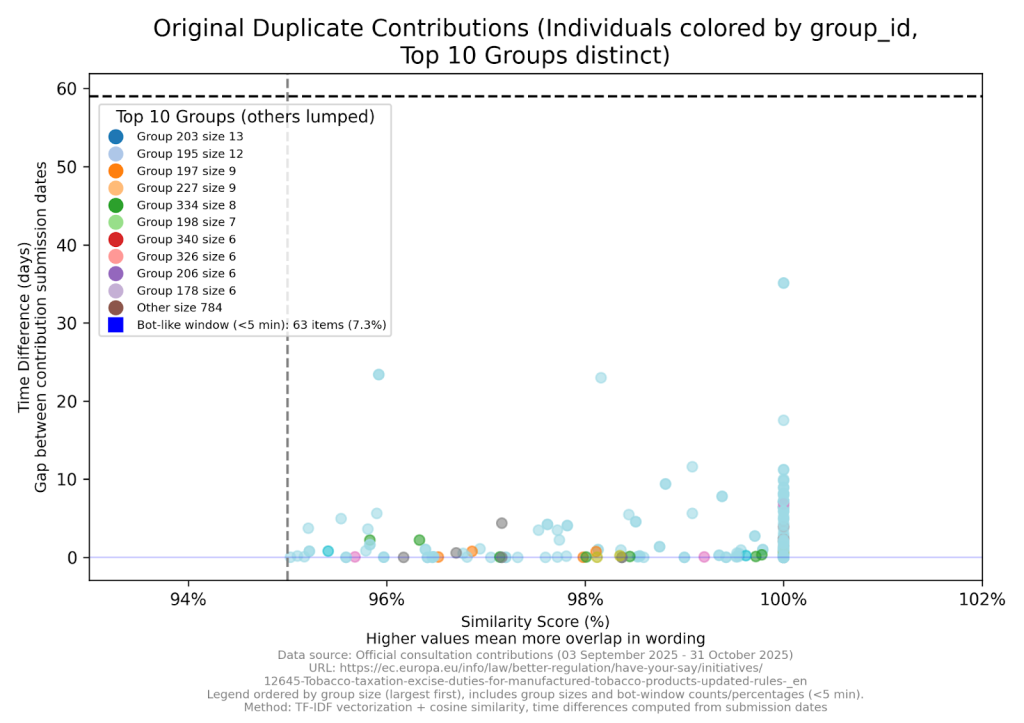
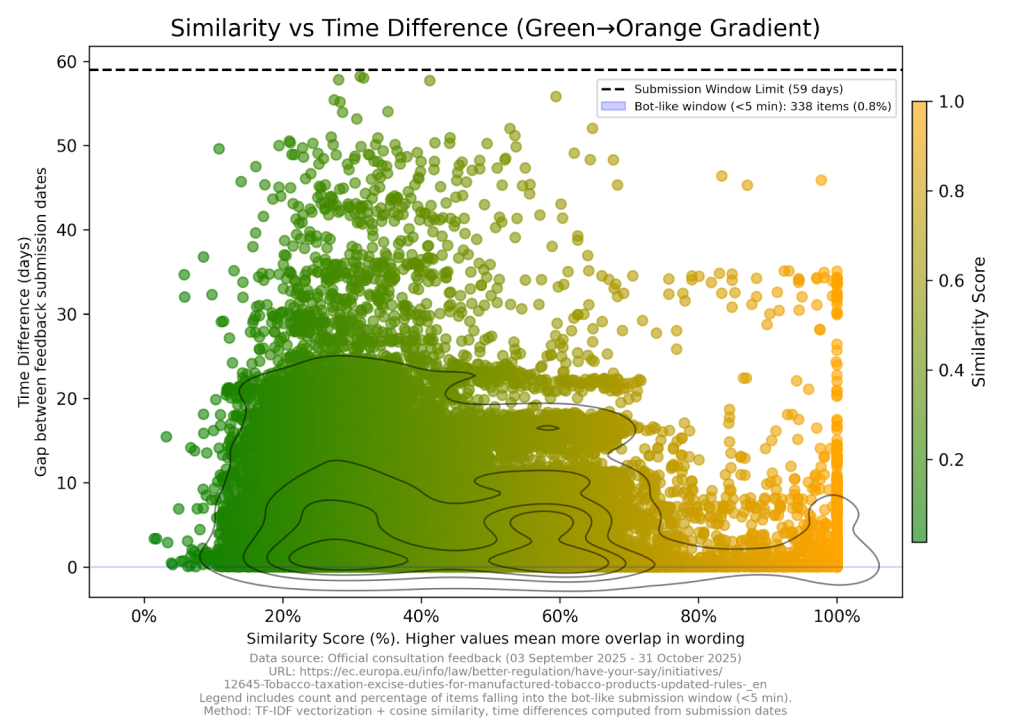
But just in case, we did a bot analysis. The most obvious thing bots do is repeat the same text over and over again. So Hans created a script to filter the entries in separate sheets and filter out meaningless things like “see attached file” and calculate similarity. When looking at the text submitted in the original poster’s language we see the highest repeating text is 11 times with the shortest time between them of 174317 seconds, or 48 hours.
For translations we drop to 7 times with a shortest time between them of 30818 seconds, or 8.5 hours and for short texts (10 or less words) the highest repeat rate is 15 times with the shortest time between them being 12937 seconds, or 3.5 hours. As for various attachments, we found 28 duplicates, with one being submitted 6 times.
These are not signs of bots being used.
Not bots, but “sock puppets”?
Since we can dispense with the “these are not real people” argument, what remains is that respondents are, as Rutger Bregman argues on his LinkedIn, “corporate sock puppets”.
There is no way Bregman can stand up that claim, or the insinuation that respondents are somehow paid. But there absolutely were campaigns to make people aware of the proposals and encourage them to voice their opposition to it. This is normal in a functioning democracy.
An article from an online retailer in Sweden told customers that the EU wants to dramatically raise the price on snus and that if they don’t like it, they should respond to the consultation. The article offers text that you can copy/paste into the feedback box, and it seems that 45 people did just that.
Hell, we’re doing something similar for the Tax Directive itself: our readers can use our tax calculator to see what it’ll cost them and then write to their MEP. A few already have. Are these people “corporate sock puppets”? Or are they just regular people who don’t want to pay more for snus?
Generating lots of responses to a consultation from your supporters is a classic tactic in a legislative campaign, and it’s usually favoured by the kind of NGO types that Bregman would feel at home with.
If you think there were a lot of responses to this consultation, the one on sustainable corporate governance got 473,461. But here’s the interesting thing: only 6,619 unique responses were received for that consultation, with the remainder the kind of “copy/paste” responses Bregman rails against in his LinkedIn post.
The Commission itself recognises that the response rate was driven by NGOs like Anti-slavery International, Avaaz, Clean Clothes Campaign, Global Witness, Friends of the Earth Europe and so on, who used prefilled questionnaires to garner 472.606 consultation responses. Just 0.1% of responses came outside of this structure. By contrast, of the 18.611 responses to the tobacco tax consultation, just 133 were “copy/paste” campaign responses (according to the Commission’s data).
There is nothing wrong with either approach. It’s good for democracy that stakeholders are educating the public about policy issues, making the case for their positions and getting citizens to sign up for them via an official forum like a consultation. I suspect Bregman might agree with me here.
But what is good for the goose is good for the gander. Maybe people just disagree with Bregman on this, and those people are making their case. “Citizen activation is only good when the citizens agree with me” isn’t a good look if your whole schtick is “moral ambition”.
The claim: lots of people (6.000) used the term “harm reduction”, which is an industry term, so their responses must have been driven by the industry.
Calling “harm reduction” a tobacco industry term would puzzle anyone who has experience of the HIV/AIDS movement, which mainstreamed it in the 1980s. It also ignores the fact that harm reduction is classified as a tobacco control measure in the WHO’s Framework Convention on Tobacco Control.
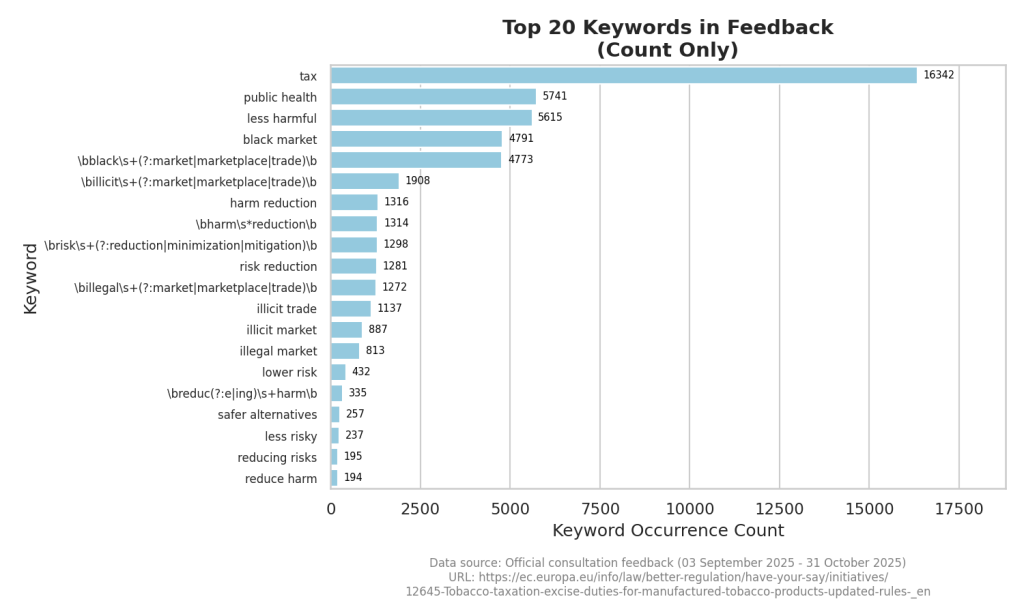
But, for the sake of argument, let’s say it was an “industry narrative” and that using the phrase “harm reduction” genuinely did mark you out as some kind of industry fraud. Our analysis showed that the term “harm reduction” was actually used 1.316 times, not the 6.000 that Impact Unfiltered claims. “Less harmful” was used over 5.000 times, but that’s just a statement of fact. Safer nicotine products are less harmful than smoking. What’s wrong with pointing that out?
The claim: the “real” stakeholders – health NGOs – are outnumbered and outgunned.
This falls into the “so what?” category. Both represent a classic piece of NGO trickery, intimating that only those with poor morals could possibly disagree with them, and that the “good guys” are outnumbered.
It’s not the fault of nicotine consumers, retailers, “big tobacco” or anyone else that health NGOs failed to mobilize their base. It’s probably because they don’t really have a base. Your average citizen is directly affected by taxing safer nicotine products if they use safer nicotine products. Most others shrug because it doesn’t affect them, so it’s not really their problem. Most people will tell an online survey that they support “strong” tobacco control measures, whatever that means, but they won’t go into battle for prohibition when confronted with specifics. Those being asked to pay up will. This should be fairly obvious.
According to Impact Unfiltered, just under 90 “health NGOs” responded to the consultation. We fed the responses of the 89 NGOs who responded into an LLM and only 41 of them uncritically support the Commission’s absolutist stance. 26 question the Commission’s approach (many preferring harm reduction), and 21 are unclear. Does that mean half of these health NGOs are also somehow controlled by Big Tobacco?
The claim: many pro harm reduction submissions came from Sweden, where the tobacco industry is strong. These must be from dubious sources.
Impact Unfiltered doesn’t seem to have done a huge amount more than just look at the number of submissions from each Member State and decide that because Sweden has so many supporting harm reduction, it must be the subject of strong industry interference.

Together with the Swedish publication Vejpkollen, we decided to figure out who was behind the campaigns that led to that kind of response. And the answer is real people who would be affected by the proposal to massively increase taxes on nicotine pouches, which are very popular in Sweden.
“To be told that you basically don’t exist, and that your opinions aren’t worth anything — that’s a punch in the gut. You wonder what kind of people think that way,” says Samuel Lundell, chair of the Swedish snus users association Snusarnas Riksforbund, which managed the largest campaign.
“We’re a volunteer organization and can’t do this during work hours. The same goes for our members. But since the proposal would drastically increase the price of nicotine pouches — and eventually traditional snus as well — we felt we had to act. The Commission is spreading false information about the risks of snus and e-cigarettes, and we’re not going to let that pass unchallenged” he told Vejpkollen.
Lundell created a special section on his website to make participation easier. In addition to instructions on how to register on the EU’s site — with email and personal details — they also added an AI generator to help members formulate their comments.
No doubt someone in the tobacco control world will read this and decide that using AI is somehow cheating. “Writing a well-structured comment is quite hard for many ordinary people” argues Lundell. “Some just want to be left alone to use their snus in peace; others are simply angry at the EU in general. The AI generator opened many doors for us, helping people focus their engagement”. He estimates that around 2.000 people used the system to submit their views.
What’s really going on here?
I could go on but this article is already way too long. Put simply, a new and untested NGO born out of Bloomberg money is trying to make a name for itself by using unpublished “studies” to bully political decision makers into ignoring the views of citizens because those citizens are somehow bots or “corporate sock puppets” controlled by the evil Big Tobacco.
Instead of making a coherent argument, Impact Unfiltered resorts to making sweeping statements on social media based on half truths. Those half truths are then picked up by the media outlets that EU policymakers rely on.
Why might they want to do this? It’s simple: politicians rely on public support, the public doesn’t support harsh taxes on safer nicotine products, they very much do (and their funding is presumably based on that view), and in order to get their way they have to discredit legitimate opposition expressed though the proper channels. So they conflate correlation and causation in the crudest way possible: these people think X, big tobacco thinks X, therefore these people must be big tobacco.
Elite-funded and elite-driven NGOs want to silence the voices of people they have never met for political reasons and personal gain; they’re using extremely underhanded methods to do it; and the specialist media which serves the EU institutions is playing along unquestioningly. If you think about it, that’s quite sinister.
The thing is, as far as I can tell, there is zero evidence that this is the case.

