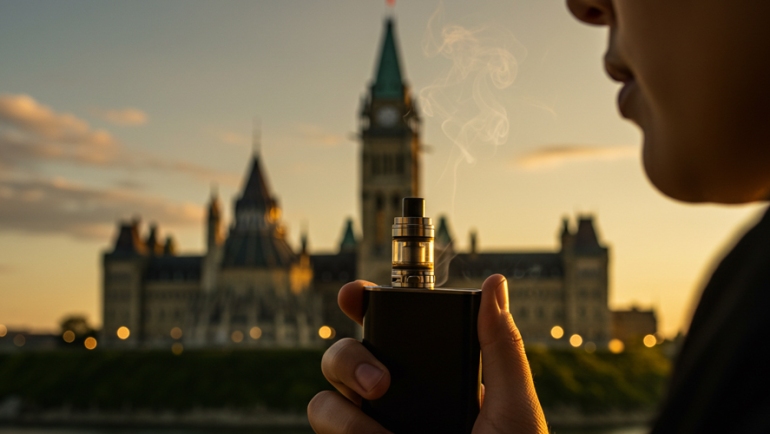
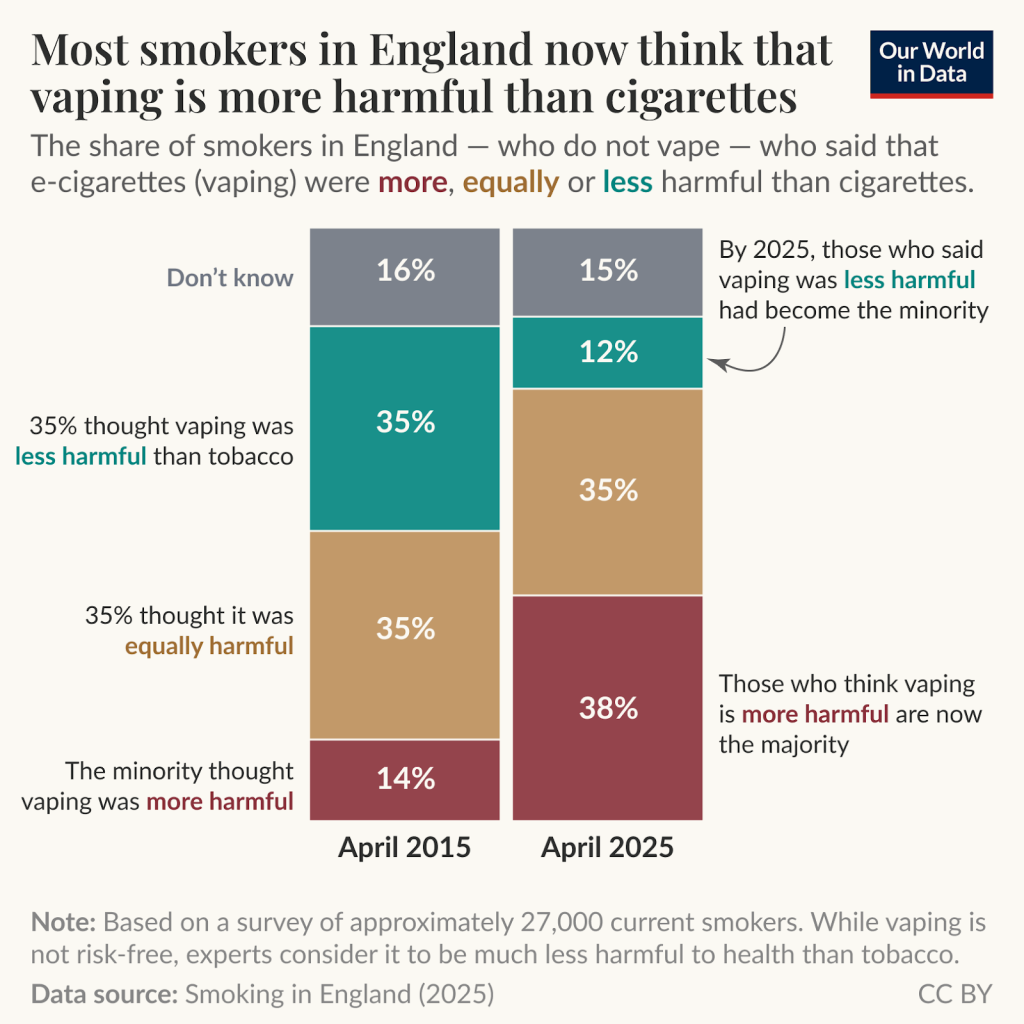
The majority of smokers in the UK now believe vaping is just as harmful – or even more harmful – than smoking tobacco, despite strong evidence that the opposite is true.
New figures from Our World in Data show a dramatic reversal in public perception over the past decade. In 2015, around a third of smokers correctly said vapes were less harmful than tobacco. Today, just 12 per cent say the same, while nearly four in ten now believe vaping is more dangerous.
Source: Our World in Data
It’s a striking shift, and one that public health experts say could cost lives. “This is a tragic reversal,” said Dr Delon Human, leader of Smoke Free Sweden and former secretary of the World Medical Association.
“The science is crystal clear that vaping and other smoke-free products are far less harmful than cigarettes. But fear-mongering headlines and confused policies are driving smokers back to the most dangerous form of nicotine use: burning tobacco.”
A decade of mixed messages
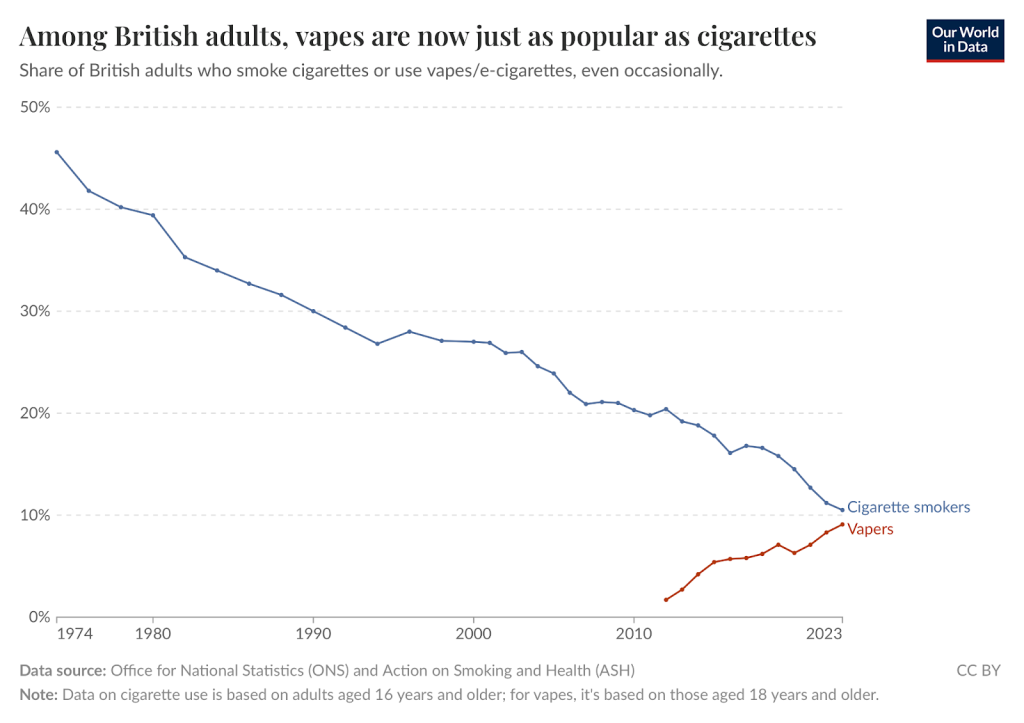
The rise in vaping has been swift. According to data from the Office for National Statistics, around one in ten British adults now use vapes, which is roughly the same share who still smoke.
Cigarette use has plunged from half of adults in the 1970s to around 13 per cent today, while vaping has climbed sharply since its arrival in the early 2010s.
Among 16 to 24-year-olds, nearly 30 per cent now vape – far more than any older age group.
Source: Our World in Data
Fruit-flavoured clouds have replaced the cigarette smell of past decades, and for many, that cultural shift has triggered a backlash. Tabloids have helped fuel fears, with regular stories about “vape-related lung injuries” and “teen addiction.”
Public health campaigns have often struggled to balance two messages at once: that vaping is not harmless, but is still far less risky than smoking.
Misunderstanding that costs lives
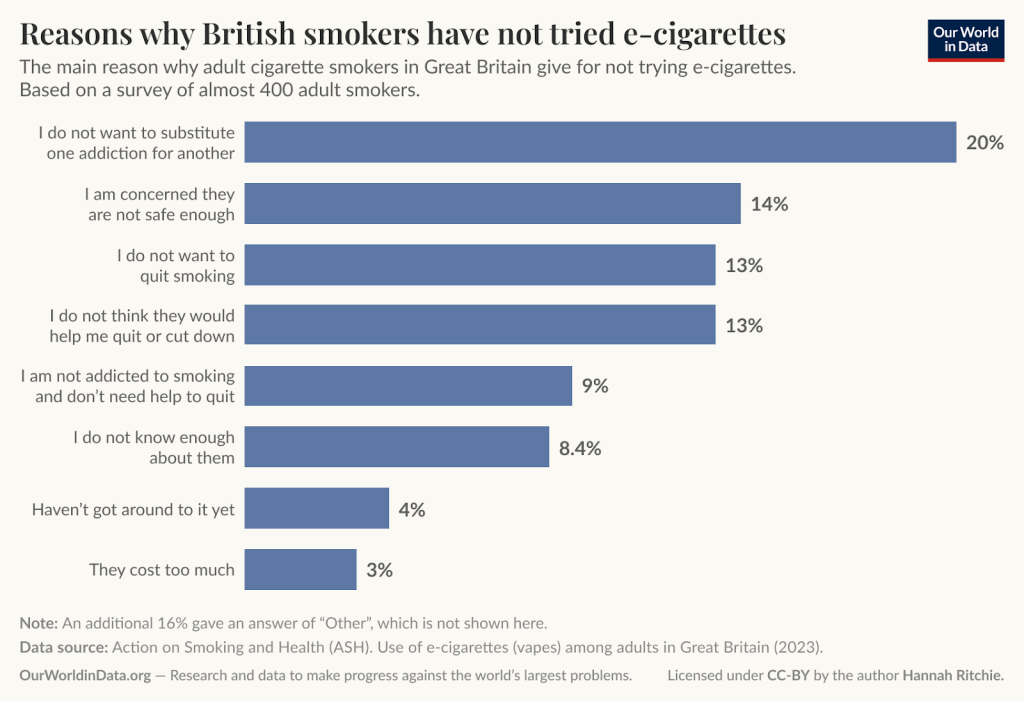
The consequences of this confusion are clear in the data. When British smokers who haven’t tried vapes were asked why, one in five said they didn’t want to “substitute one addiction for another.” Another 14 per cent said they feared vapes weren’t safe enough, while 13 per cent doubted they would help them quit.
Source: Our World in Data
But the evidence tells a different story. Vaping is now the UK’s most effective quitting aid. The Cochrane Collaboration, regarded as the gold standard for medical evidence, found “high-certainty” proof that smokers who use vapes are more likely to quit successfully than those using patches, gum or going cold turkey.
That aligns with population trends. More than half of ex-smokers who quit in the last five years say they used vapes to do it.
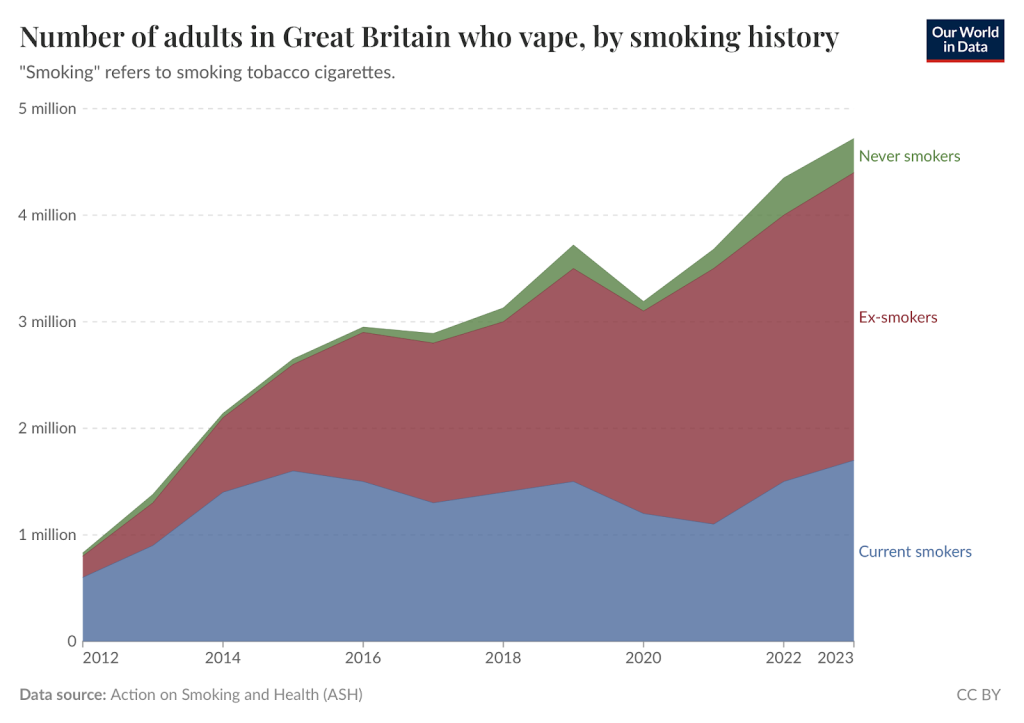
Source: Our World in Data
Why vaping is less harmful
The science behind vaping’s relative safety is straightforward. When you light a cigarette, tobacco burns, releasing tar, carbon monoxide and thousands of toxic chemicals, many of them carcinogenic. That combustion is what makes smoking deadly.
Vapes, by contrast, heat a nicotine-containing liquid to create a vapour. There’s no burning, and far fewer toxins. While vaping isn’t risk-free, studies show the overall exposure to harmful substances is drastically lower than in cigarette smoke.
England’s Chief Medical Officer, Professor Chris Whitty, said: “If you smoke, vaping is much safer. If you don’t smoke, don’t vape.”
The youth question
Critics often point to rising youth vaping as proof that vapes are a public health menace. But the data doesn’t show a surge in teenage smoking. In fact, smoking among 15-year-olds in England has fallen to its lowest level on record.
In the early 1980s, more than half of pupils aged 11 to 15 had tried smoking; today, just 12 per cent have. Regular smoking among 15-year-olds has dropped from around 30 per cent to barely five per cent.
If vaping is truly a “gateway” to cigarettes, those numbers would be rising — not falling.
Sweden shows what’s possible
The perception gap isn’t just an academic issue, it has real-world consequences. Sweden, which has embraced safer nicotine alternatives such as snus, pouches and vapes, has cut daily smoking to just 5.3 per cent, the lowest in Europe. Lung cancer death rates among Swedish men are now 61 per cent lower than the EU average.
“Sweden’s success didn’t come from bans or fear,” said Dr Human. “It came from trust in science and honesty with smokers. If you can’t quit nicotine, switch to a safer product. It’s that simple.”
Closing the confidence gap
Back in Britain, the challenge is rebuilding trust. The same Our World in Data survey shows that smokers who have never vaped are far more likely to believe vapes are more harmful than tobacco, while those who’ve used them – or quit smoking entirely – overwhelmingly recognise they’re safer.
That misunderstanding could be preventing millions from making the switch.
Smoking remains the UK’s leading cause of preventable death, responsible for one in seven adult deaths each year. Replacing cigarettes with vapes won’t solve every problem, but it could save countless lives.
“Equating vaping with smoking is a lie that costs lives,” said Dr Human. “Misinformation kills confidence, and without confidence, smokers won’t switch.”