


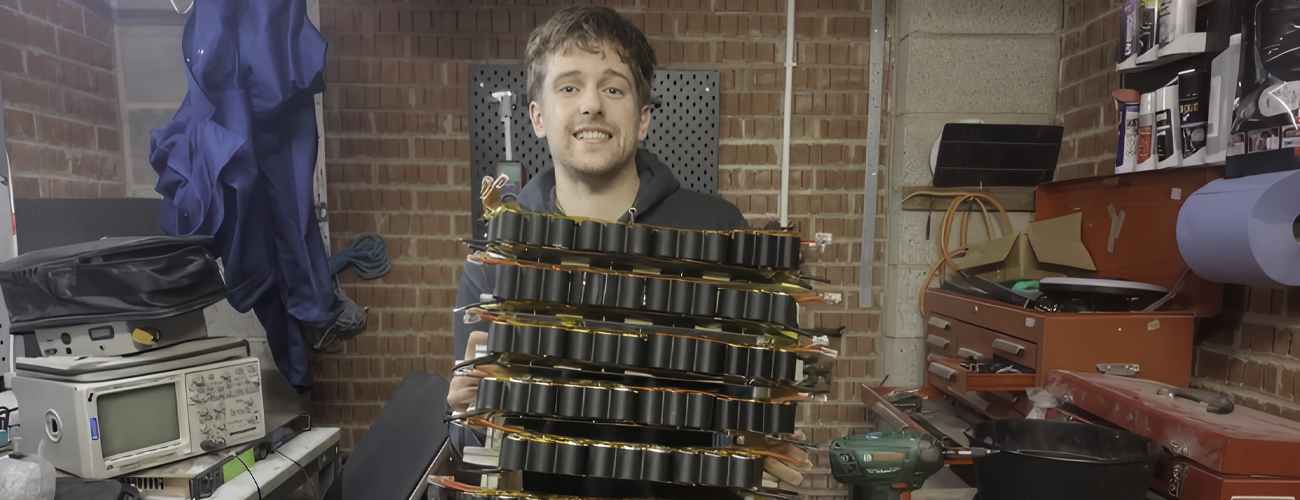
A UK engineer and YouTuber has repurposed 500 disposable vapes into a working powerwall capable of running both his home and workshop.
The project, created by Chris Doel, uses lithium-ion batteries salvaged from discarded single-use vape devices to show how e-waste can be transformed into usable energy.
Doel’s setup delivers around 50 volts and roughly 2.5 kWh of usable capacity – “enough juice for up to eight hours of home usage or three days of work,” he said.
From vape bin to power bank
The process began with collecting hundreds of used vapes returned to stores or picked up from recycling drives. Each unit had to be stripped down to its core components, a laborious task that involved removing the internal circuitry, desoldering the wires, and extracting the rechargeable lithium-ion cells. “A battery is more or less useless if its charge drops below 3V,” Doel explained, meaning each cell had to be carefully tested before reuse.
Once the viable batteries were identified, they were sorted by capacity and connected in parallel inside 3D-printed modules. Several of these modules were then linked in series to form a wall-mounted battery pack. The array was connected to an inverter that converts the 50V DC output into standard 240V AC – the same voltage used in UK homes.
The finished powerwall now powers lights, tools, and testing equipment in Doel’s workshop and also sends electricity back into his house to run computers and appliances.
Tackling the vape waste crisis
The project arrives amid growing concern about the UK’s disposable vape problem. A December 2024 report by Material Focus estimated that 8.2 million vapes – including single-use, pod, and “big-puff” models – are discarded or improperly recycled every week. Each contains a rechargeable battery that could be recovered and reused but often ends up in landfill, where it poses fire risks and adds to the country’s e-waste burden.
The UK’s ban on disposable vapes, which came into effect in June 2025, was introduced partly in response to this growing environmental issue.
Campaigners have pointed out that the same lithium that powers these throwaway devices could instead be feeding the renewable energy industry, in home batteries, electric vehicles, and grid storage.
Doel’s creation joins a small but growing movement of DIY engineers and makers experimenting with reclaimed cells. Similar “second-life” battery projects have used cells from electric scooters, laptops, and even discarded EV packs to create low-cost energy storage for off-grid or backup use.
Not one for beginners
While Doel’s work highlights what’s possible with ingenuity and persistence, he cautions that it isn’t a beginner-friendly project. Working with lithium-ion cells carries serious fire and safety risks if done incorrectly. Proper insulation, balancing, and a battery management system are essential for safe operation.
Still, his powerwall stands as a striking example of how innovation can turn waste into wattage. With the UK’s disposable vape ban now in force, Doel’s project offers a glimpse of how yesterday’s throwaway tech can help power tomorrow’s homes – one battery at a time.

