Almost half of the vaping products consumed across the European Union may be bought outside the regular market, with irregular sales worth an estimated €6.6 billion, according to a major analysis of the sector.
The study by Germany’s Fraunhofer Institute for Integrated Circuits IIS and logistics consultancy MRU GmbH estimates that around 48 per cent of vaping products consumed across the EU can be attributed to grey or black market activity.
That includes around 13 per cent bought privately through unofficial channels for personal use and a further 35 per cent attributed to commercial black market trading.
In financial terms, the researchers put the grey market at around €1.8 billion and the commercial black market at €4.8 billion.
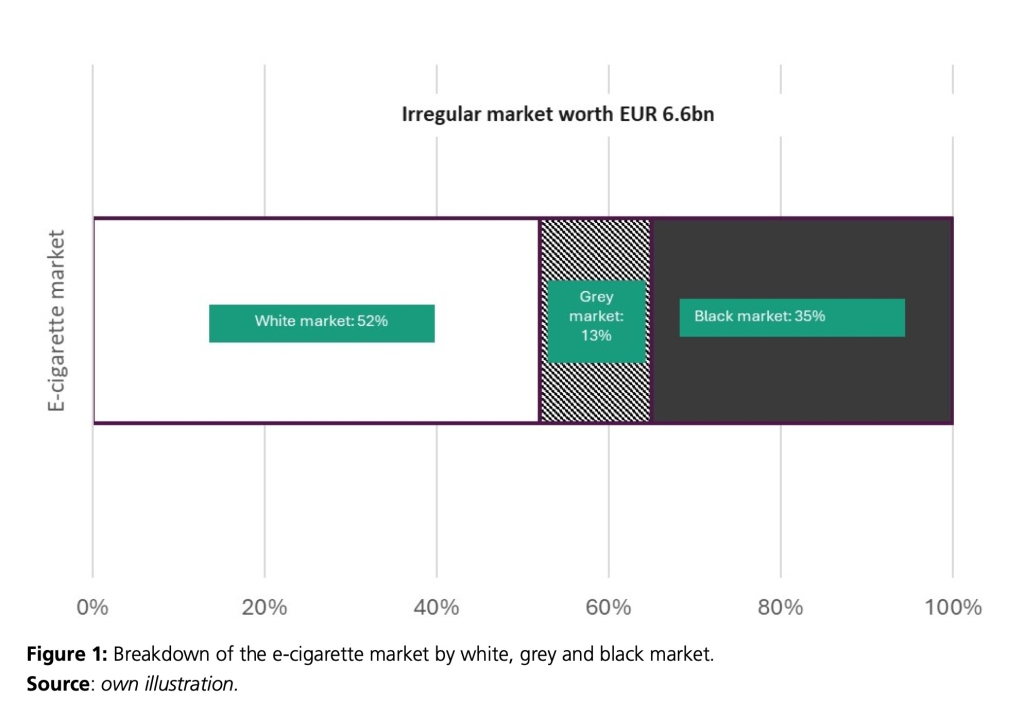
And the problem could grow significantly. Assuming annual growth of 8.6 per cent, the report projects the irregular market could reach €10.83 billion by 2030.
That growth rate is an assumption based on an average of wider vape-market forecasts cited by the researchers, rather than a directly observed growth rate for illegal sales.
Almost half of vape consumption may be irregular
The researchers developed an economic model comparing estimated demand for vaping products in each EU country with official trade data, including imports and exports.
Any demand that could not be accounted for through official figures was classified as part of the irregular market, before being divided between grey and black market activity according to factors including national regulations, taxation, prices and consumer behaviour.
For the purposes of the study, the grey market includes people privately buying untaxed products or products that are not permitted in their own country. The black market covers commercial sales of illegal, counterfeit or untaxed products for profit.
The 48 per cent figure refers to physical quantities of vaping products rather than their monetary value.
The researchers acknowledge that their calculations rely on a series of assumptions and say the figures should not be treated as precise measurements.
The report states: “Despite the distinction between liquids and disposables as well as the grey and black markets, the following results should therefore not be construed as definitive values but as model-based estimates and interpreted accordingly with caution.”
The €6.6 billion valuation is also described as a conservative estimate, because it’s based largely on average online retail prices rather than potentially higher prices further down the retail chain.
Germany’s irregular market estimated at 36 per cent
There are wide differences between individual countries. In Germany, for example, the study estimates that 36 per cent of the overall vape market cannot be traced through official statistics.
Of that irregular market, around 20 per cent is estimated to involve grey market purchases, while 80 per cent is attributed to commercial black market sales.
The researchers calculate that illegal trade could be costing the German government around €119 million a year in lost tax revenue.
Across Europe, the report says irregular trade tends to be greater where taxes are higher and rules differ significantly between neighbouring countries, creating incentives for cross-border buying and unofficial sales.
Around 11.9 million people aged 15 and over in the EU use vapes, equivalent to 3.1 per cent of the population in that age group, according to European Commission data used in the study.
China dominates European vape imports
The study also examines how vaping products enter Europe. Around 90 per cent of vapes imported into the EU come from China, according to the report, with the Netherlands, Germany and Belgium acting as major entry points.
EU imports of nicotine liquids and vapes from countries outside the bloc rose from around 30,900 tonnes in 2022 to more than 45,000 tonnes in 2024.
The researchers argue that the sheer volume of international shipments, combined with complicated supply chains and limited physical customs inspections, makes it difficult to identify non-compliant products.
They also point to inconsistencies in customs classifications and differences between national regulatory systems, which can make the market harder to track.
Researchers warn bans could fuel illegal sales
The report questions whether national bans or increasingly restrictive rules will solve the problem.
It says: “National unilateral action and solely prohibition-based approaches have so far proven to be ineffective and tend to serve the expansion of the grey and black market via intra-European free trade.”
The researchers also consider a blanket ban on vaping products or individual categories such as disposables.
They write: “A closer analysis of the existing consumer base, however, suggests that this measure is not expedient and may even be counterproductive.”
With almost 12 million regular or occasional vapers already estimated across the EU, the report argues that removing legal products could push some existing consumers towards cigarettes or the black market.
Instead, it calls for greater coordination across Europe, including more consistent product standards, approval procedures and taxation, alongside improved customs data and supply-chain tracking.
It also recommends closer cooperation with China, more targeted import controls and better systems for identifying manufacturers and distributors linked to illegal products.
The study was published in February 2026 by Fraunhofer IIS in partnership with MRU GmbH and was commissioned by SKR AG in Lucerne, Switzerland.