
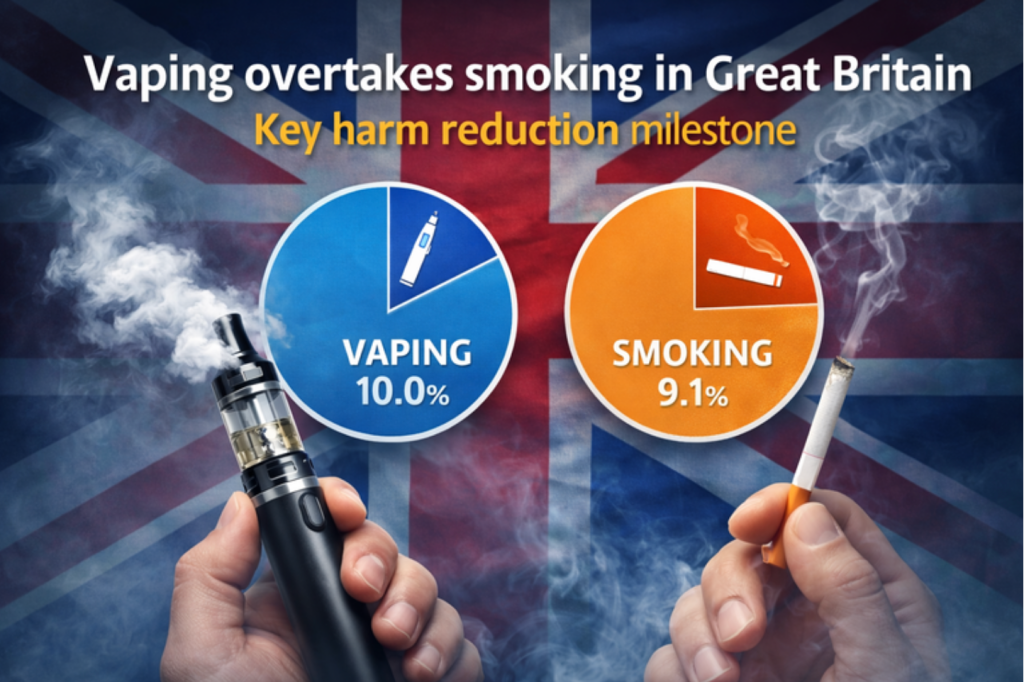
- Vaping has surpassed smoking in Great Britain for the first time on record
- 10.0% of adults now use vapes, compared with 9.1% who smoke
- Smoking has halved since 2011, falling from 20.2% to 10.6%
- The vast majority of people who vape are current or former smokers
Vaping has overtaken smoking in the UK for the first time ever – a landmark moment that could reshape the future of tobacco control and marks a decisive shift away from combustible tobacco.
Source: CoEHAR.org
It is a crossover that would have been almost unthinkable a decade ago, when smoking still dominated nicotine use.
The finding comes from a new CoEHAR (Centre of Excellence for the Acceleration of Harm Reduction) commentary published in the International Journal of Public Health, which describes the crossover as a “notable milestone in tobacco control”.

Source: Harm reduction implications of vaping overtaking smoking in Great Britain
For the first time since records began in 1974, 10.0 per cent of adults now use vapes, compared with 9.1 per cent who smoke. In absolute terms, this equates to around 5.4 million people using vapes compared with 4.9 million smokers.
The figures are based on data from the UK Office for National Statistics (ONS), which track national smoking and vaping trends.
A tipping point moment
Taken together, the figures point to a profound shift in nicotine use across the population. What was once dominated by combustible tobacco is now increasingly being replaced by lower-risk alternatives.
Smoking is still one of the leading causes of preventable death, responsible for cancers, heart disease and lung conditions, and killing up to half of long-term users.
The authors note that this crossover has occurred alongside “sustained declines in smoking prevalence” and is “consistent with harm reduction approaches operating alongside traditional tobacco control measures”.
Smoking has been falling for years, but this is the first time it has been overtaken by a lower-risk alternative. Prevalence has dropped dramatically from 20.2 per cent in 2011 to 10.6 per cent in 2024.
Not a new problem – a shift away from smoking
Crucially, the data does not point to a surge in new nicotine users. Instead, vaping is overwhelmingly concentrated among people who already smoke or used to smoke.
Around 55 per cent of people who vape are former smokers, 40 per cent still smoke alongside vaping, and only a small minority – around five per cent – have never smoked.
The paper also notes that 32.8 per cent of current smokers use vapes, highlighting how closely linked the two behaviours now are.
The authors say this distribution shows vaping is concentrated “primarily among individuals with a prior smoking history”, with “complete switching more common than persistent dual use”.
Only a small proportion of never-smokers report vaping, indicating that “population-level harm reduction benefits likely outweigh risks of nicotine uptake among those unlikely to have smoked otherwise”.
Dual use is part of the picture
The persistence of dual use often fuels criticism, but the CoEHAR analysis paints a more nuanced picture.
“Dual use should be interpreted cautiously,” the authors say, noting it “often represents a transitional stage within a substitution pathway rather than a stable end state for many individuals”.
The paper adds that dual-use patterns are often “behaviourally dynamic” and can progress towards cessation of smoking for a proportion of users.
The science behind the shift
Switching away from cigarettes significantly reduces exposure to harmful chemicals.
The paper highlights findings showing reductions of “90 per cent or more” in biomarkers of exposure to tobacco-specific carcinogens among those who switch completely to vaping, with levels that can “approach levels observed in non-users”.
The UK as a global case study
At a population level, the UK is emerging as a real-world example of successful harm reduction in practice.
Smoking has continued to fall to historic lows during the same period that vaping has become widespread.
The commentary highlights a “temporal association” between rising vaping prevalence and sustained declines in smoking, with multiple lines of evidence supporting this interpretation.
Among young adults, smoking has dropped sharply, while vaping has stabilised or declined. The authors say this pattern “suggests that any gateway effects are outweighed at the population level by diversion away from combustible tobacco”.
In effect, Great Britain is becoming a real-world test case for how quickly smoking can decline when lower-risk alternatives are widely available.
An ‘historic shift’
Professor Riccardo Polosa, co-author of the commentary and founder of CoEHAR, says: “This is a historic shift. Seeing vaping overtake smoking at a population level suggests that many smokers are moving away from combustible tobacco. The key challenge now is to ensure that policies continue to protect young people while not restricting access to less harmful alternatives for adults who smoke.”
The paper warns that overly restrictive policies risk slowing progress or pushing users back to cigarettes or into unregulated markets.
The authors conclude that substitution pathways can yield measurable public health benefits when smokers are given access to “accessible, appealing, and appropriately regulated alternatives to combustible tobacco”.