A new vape study is fuelling fresh fears about toxic metals – but experts say the science behind the headlines is far less clear.
Published in Analytical and Bioanalytical Chemistry, the research explored whether metals from vape aerosol can build up in lung tissue. Using a mouse model, scientists exposed animals to aerosol from a refillable device and reported detecting metals including nickel, copper and lead in both the aerosol and lung tissue.
The authors say the results demonstrate “measurable metal accumulation” and point to potential health risks. But critics argue the study also highlights how complex laboratory findings can be presented without the context needed to understand what they mean in the real world.
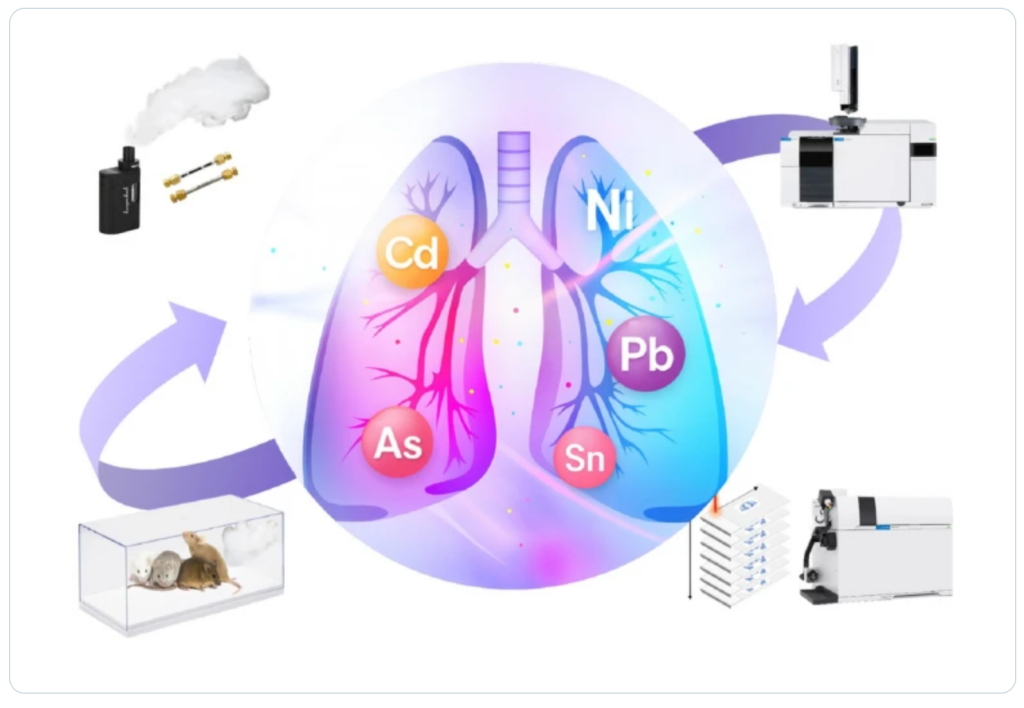
Source: ‘Analytical investigation of metal distribution from e-cigarette aerosols to lung deposition using multi-platform mass spectrometry’
A study under the microscope
The study exposed mice to up to 32 puffs of aerosol, twice daily over four days, before analysing lung tissue using mass spectrometry techniques.
Researchers detected a range of metals in both aerosol and lung tissue, including nickel, copper and lead, along with what they described as “metal-containing (organometallic) species”.
Some metal concentrations increased after exposure. Others, notably iron, decreased. Patterns varied across different parts of the lung and were “not strictly dose-dependent”.
That complexity is acknowledged in the paper itself, which describes the findings as reflecting “a complex deposition and clearance mechanism”.
But once the study reaches the headlines, that detail can quickly disappear.
“Too many information gaps”
Roberto Sussman, a physicist who has analysed vaping research extensively, said the study has “too many information gaps” and is “unreproducible”.
He pointed to missing detail on how the aerosol was generated, including the absence of clear information on temperature and puffing protocol.
These variables are central to understanding any vaping experiment. Change the temperature or puff duration, and the composition of the aerosol can shift significantly.
Without that information, it becomes difficult to interpret the findings, or to compare them with other studies. Sussman was also critical of how the results are framed, saying: “It is annoying how they build a horror narrative out of thin air.”
The device problem
Another issue is the device used in the study. Researchers used a refillable KangerTech CUPTI device with a nickel-chromium coil – a model that is now largely outdated.
Sussman said that “less than 0.01% of vapers use KangerTech CUPTI”, arguing that the findings are “not applicable to most users vaping pods or disposables”.
This matters because the vaping market has shifted significantly, with pod systems and disposable devices now dominating.
Device design plays a major role in metal emissions. The study itself acknowledges that concentrations vary depending on materials, manufacturing quality and user behaviour.
That variability has been a consistent theme across the scientific literature.
The same pattern across studies
Research into metals in vaping has been building for more than a decade, and it has produced a familiar pattern. Metals are often detected, but the levels vary widely.
A 2018 study found that heating coils can transfer metals into aerosol, with concentrations differing significantly between devices. A 2017 study identified potentially toxic metals in some products, but again highlighted large variation.
A 2020 systematic review found metals in e-liquids, aerosol and biological samples – but stressed “substantial heterogeneity” (significant variation) across studies, products and conditions.
More recent research has reinforced the point. A 2025 study of disposable vapes reported elevated metal emissions in some products, suggesting that newer devices may behave very differently from older refillable models.
Taken together, the evidence does not point to a single, consistent exposure profile, but to a highly variable one.
Detection vs risk
One of the most important distinctions in this area is the difference between detecting a substance and demonstrating harm.
Sussman said: “The study did not detect concerning levels of metal. They are all below toxicological markers. However, the authors did not compare the metal yields of the aerosol with these safety standards (only the e-liquids).”
That gap is important. The study compares metal concentrations in e-liquid with pharmaceutical inhalation limits, noting that several elements exceed those benchmarks.
But what matters for users is the aerosol (what is actually inhaled), not just the liquid. And while metals were detected in aerosol and lung tissue, the study does not establish whether those levels would be harmful to humans.
There are currently no widely established regulatory thresholds specifically for metals in vape aerosol.
A wider issue in how exposure is modelled
Concerns about methodology are not limited to a single study.
Commenting on separate research into second-hand vape exposure, Sussman criticised how some studies attempt to simulate real-world conditions.
“The authors of this paper are toxicologists trying to improve the protocols of cytotoxic exposure,” he said. “The cytotoxicity part is impeccable, but the authors are quite ignorant on the properties of environmental vaping.”
The study he was referring to examined second-hand vapour exposure using machine-generated aerosol and particle measurements.
Sussman argued that this approach fails to reflect how aerosol behaves in real-world conditions. “Environmental vapes cannot be generated by a machine,” he said, adding that once inhaled and exhaled, aerosol undergoes major physical and chemical changes.
What newer research says about metals
Recent work also suggests that how metals appear in studies may not always reflect typical use.
A 2025 preprint analysis by Sussman and colleagues argued that elevated metal levels found in some disposable devices can be explained by corrosion inside the device during storage, rather than aerosol generation alone.
The authors found that some devices already contained high levels of metals in the e-liquid before testing began, and concluded that failing to account for this “initial defective state” could lead to misleading comparisons with other products.
They also warned that some studies may overestimate risk by using “unrealistic” exposure assumptions and inappropriate lifetime risk models.
From mice to humans
The study’s use of a mouse model adds another layer of uncertainty. Mice were exposed under tightly controlled conditions, with fixed puff numbers and chamber-based exposure. That is very different from real-world vaping, where behaviour varies widely.
Animal studies can show that a mechanism is possible – in this case, that metals can deposit in lung tissue. But they cannot show what happens in human populations over time.
The study itself acknowledges this, calling for further research, including longer-term and human studies.
Mixed results, simple headlines
Even within the study, the results are not straightforward. Some metals increased while others decreased. Patterns were inconsistent and not clearly dose-related.
Iron levels, for example, fell significantly across exposure groups, while other metals showed uneven, region-specific accumulation.
These are complex findings, but complexity does not always translate into headlines. Instead, studies like this can be interpreted as evidence of harm, even when the underlying data is more ambiguous.
What the latest study shows – and what it doesn’t
The study provides detailed analytical evidence that metals can be present in vape aerosol, that metal-containing species can be detected, and that short-term exposure can alter metal levels in mouse lung tissue.
But it does not show that vaping causes disease in humans, that the levels detected are harmful, how these exposures compare with smoking, or how modern devices perform under real-world conditions.
Even the authors emphasise the need for further research and acknowledge limitations in their model.
A wider issue in vaping research
The debate around metals is part of a broader pattern in vaping science.
Studies can produce striking findings under laboratory conditions, but those findings do not always translate cleanly into real-world risk. Missing methodological detail, outdated devices, lack of dose context and reliance on animal models all make interpretation more difficult.
At the same time, once findings are published, they can quickly shape public perception.
The impact
Vaping is widely used as an alternative to cigarette smoking, which is known to cause serious disease and death. Understanding relative risk is critical in interpreting these findings, but that requires careful interpretation of the evidence, not just headline findings.
Research on metals can help identify issues with device design and manufacturing. It can inform regulation and improve product standards.
But without context, it can also contribute to confusion.
The latest study adds to the evidence that vaping can expose users to metals under certain conditions. But it also highlights how easily those findings can be taken further than the data allow.
Without clear information on exposure levels, device relevance and toxicological thresholds, detection alone tells only part of the story.