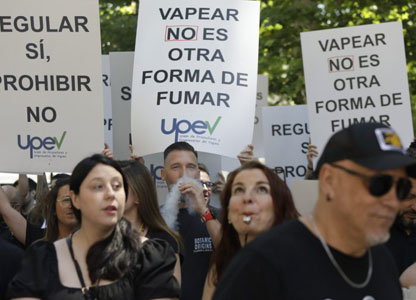

Belgium’s health minister has urged the European Union to tighten rules on vapes, warning that use is becoming an “epidemic” and calling for a bloc-wide crackdown.
Speaking during a visit by Michael McGrath to Sciensano, Belgium’s public health institute in Brussels, Frank Vandenbroucke said vaping is rising rapidly among young people and accused the industry of targeting minors.
He warned that vapes contain “thousands of ingredients,” including metals and chemical compounds formed when heated, which he said may pose health risks.
Call for EU-wide crackdown
Vandenbroucke is calling on the EU to introduce stricter limits on the substances allowed in vape products, alongside a ban on disposable devices across the bloc.
A ban on disposable vapes is already in place in Belgium, and the minister said similar measures should now be adopted EU-wide.
He also urged tighter restrictions on flavours, pointing to rules in the Netherlands where only tobacco flavour is permitted.
Enforcement challenges at home
The push for tougher EU action comes as Belgium continues to grapple with enforcing its own national restrictions.
In the 12 months after introducing a disposable vapes ban on January 1 2025, authorities seized more than 140,000 illegal devices. Inspectors carried out nearly 2,400 checks across shops and online sellers, with illegal products found in hundreds of cases.
Nearly 600 official reports were filed and 18 shops temporarily closed, highlighting the scale of the challenge.
Enforcement data also shows wide regional differences. In Brussels, illegal disposable vapes were found in nearly 60 per cent of inspections, while in Flanders around one in five shops checked was in breach of the rules.
The figures underline how difficult it can be to control supply once restrictions are introduced, particularly in densely populated urban areas.
Wider policy shift
Belgium’s disposable vape ban forms part of a broader tightening of policy.
The government plans to ban smoking and vaping on café and restaurant terraces from 2027, and is preparing legislation that would restrict vape flavours to tobacco only.
Vandenbroucke has previously described the vape sector as a “criminal industry” and argued that flavourings are designed to “attract children and hide the harm” of these products.
Belgian officials have frequently pointed to the Netherlands as a model, although robust data on the impact of its flavour restrictions remains limited.
Concerns over unintended effects
The crackdown has also raised concerns about unintended consequences.
An investigation by Belgian broadcaster VRT earlier this year found that the disposable vape ban had pushed parts of the market underground, with unregulated products more likely to contain substances such as THC liquids or synthetic cannabinoids.
Despite the ban, disposable vapes were still reported to be widely available in some secondary schools, raising questions about enforcement capacity and product safety.
Retail groups have also warned that further restrictions, particularly on flavours, could drive more consumers towards illegal sellers rather than regulated products.
EU signals further action
McGrath said the scale of the issue is “significant” and called for stronger cooperation between EU countries.
After observing laboratory testing at Sciensano, he said the EU should make better use of existing research and improve coordination between national authorities.
The European Commission is expected to propose updated market surveillance rules later this year, which could shape how vape products are regulated across the bloc.