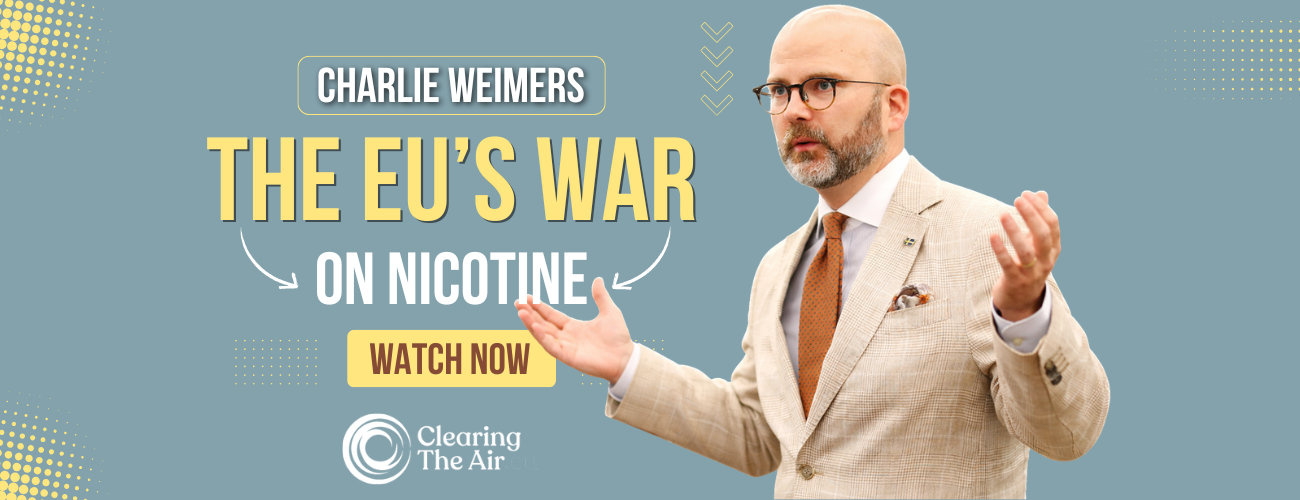

In this episode of Clearing the Air, host Peter Beckett sits down with Swedish MEP Charlie Weimers to dive into the latest friction over EU nicotine regulation. They skip the basics and get straight into why the Commission’s current trajectory is so detached from the Swedish experience, the ideological divide in Brussels, and what it’s actually going to take to protect the future of reduced-risk products in the upcoming TPD review.
Peter Beckett: Charlie Weimers, welcome to Clearing the Air. It’s great to have you. We just heard you talk very effusively about nicotine regulation and how the commission is getting it wrong. I worked a lot on the last TPD back in 2014, and I was shocked by how polarized this issue is left and right. It doesn’t make sense to me. Why? Why is it so polarized in this area when it should just be about what we know the data says?
Charlie Weimers: I think there’s a high degree of ignorance among policymakers on these topics. And they revert back to their original ideological positions, one side being a bit more liberty oriented, libertarian, if you will, pointing out the need for personal freedom, the other side, believing that the state can shape behaviour and hoping to be able to eradicate nicotine that way. In Sweden, however, we don’t see that there is such a big difference between left and right. And maybe it comes down to electoral politics. In Sweden, every party has quite a big share of voters that use snus or nicotine pouches, so they could not survive an election going against so many voters. So, eventually, maybe policymakers here in Brussels will understand that they are challenging their own electorate by singing along to the very dangerous tune of the European Commission, which will ultimately lead to more suffering, more death.
PB: So you’ve spoken quite a lot publicly about how you got involved in these issues. I believe your mother gave up smoking. So can you just walk me through that journey and how you ended up in the position you are in, the European Parliament, trying to defend reduced risk products?
CW: Well, I mean, the consequences of policy are very real. In Sweden, a lot of smokers, just like my mother, gave it up in favour of snus or nicotine pouches. And that saves lives. My mother is still alive, not suffering from any smoking related disease, despite having used cigarettes for 35 years or something like that. On the other hand, those who do not quit like my aunt, they eventually will succumb to the diseases created by combustion, by smoking.
PB: So my aunt died of lung cancer at 58, and I was particularly beaten up about it because I worked in the vaping world and for years have been sticking vapes under her nose and saying, could you please use this instead? And the message that I kept getting back was, oh, it’s all the same, it doesn’t make any difference. And I can’t get my message across because of very well funded NGOs that appear to be doing the devil’s work on this. In your role as an MEP, do you see a lot of that kind of activity, a lot of that kind of misinformation that’s directed at you and maybe your colleagues on the question of nicotine?
CW: They’re doing their best. Sweden is becoming the world’s first smoke free nation. So an organisation like a Smoke Free Generation has to fill its time with something new. Then it becomes the non-nicotine generation so that they are not losing their jobs, but by becoming that they are actually harming people, they are misinforming politicians and ignoring the gradient risk gradient harm of different products. And as far as I can see, the commission seems to be in very close touch with these organisations because the, the commissioner himself, Oliver Varhelyi has, has explicitly said that all products are equally harmful and he does not have any evidence to that claim whatsoever, but he’s got the audacity to to put that in our face as a legislator and it must be that the commission accepts the claims by the anti-nicotine lobbyists.
PB: Have you spoken to his office about this?
CW: Not yet. I’ve asked written questions, sent written questions as MEP to him which he has answered, but I’ve not been in a direct dialogue with the commissioner on this, yet.
PB: But do you think that moment will come later this year when we get a directive?
CW: Well, hopefully. I challenged the industry today by saying that if they can come up with scientifically proven research, at arm’s length, that is independent, that shows how many Swedish lives would be lost if the Commission gets its way, I will show the Prime Minister that, so that he can use it in the Council against the Commission.
I would also be more than happy to ask for a meeting with the Commissioner to discuss this. How many lives is the Commission ready to sacrifice in order to appear to be doing good?
PB: Another thing you challenged the tobacco industry on today was how timid it is. And as somebody who’s interacted with them on these issues for years, it was a breath of fresh air because I don’t feel like they are making their point forcefully enough, and I feel like they’re being drowned out more practically. This is an industry that has a well-earned reputation for being duplicitous. Let’s not pretend anything else. What do you suggest they do?
CW: I think they should talk about life and death much more. I mean not philosophically, but practically, because it all comes down to that. How many European lives could be saved? How many European lives will be lost depending on policy? Not depending on coincidence. The anti-nicotine lobby, they claim that the decrease of smoking in Sweden is due to coincidence, as if the Swedes woke up one day and realised I’m not going to smoke.
CW: No, that’s not what it was. So? So the industry must be much, much more assertive on that. And to really state very clearly that those who refuse to take in the facts. Here are the bad guys. And maybe the roles have been reversed. So I think the industry should challenge those legislators that don’t want to actually listen, because in many countries nicotine pouches, vaping, are still legal. So just like Sweden, many parties will have to pay a price if they just accept the commission line. Well, challenge them on that. Are you going to go against your voters? So this is what I’m calling for and I really hope that they do not accept that role of almost untouchables, lepers that the Commission has given it because that’s not how it should be today.
PB: I’ve worked across a lot of industries. I worked in tobacco years ago, worked in the instant delivery space. I worked in the financial services space. Every single time that somebody in Brussels doesn’t like your ideas, they immediately try and bring in the playbook from how they treat the tobacco industry. Every single time. And that playbook I think is dangerous. It’s encouraged by a sort of NGO set that exists in Brussels and until recently kind of largely existed off public money. And that seems to be a thing that directs policy across the board here.
PB: Is the Parliament able in its review of how NGOs are being treated to do something about where that influence is pervasive. I’m not saying it always is, but where it’s pervasive, it’s unrepresentative and it’s unearned. What can we do to, I don’t want to say prevent it, but take it for what it is.
CW: Well, at this very moment, the parliament is looking at this issue. And I mean, it’s utterly unacceptable that the commission pays NGOs money to lobby MEPs in favour of the commission line. That’s not legitimate in a democracy, at all. And even though there is resistance from the centre left to even touch this subject, I feel that the majority is ready to at least shine light on the issue, and I think much more needs to be done. We need stricter rules and we need much more independent NGOs, because ‘NGO’ does not really cover what it’s about. There’s a famous British expression, quangos. That is what we’re talking about here.
PB: Quasi autonomous non-governmental organisations.
CW: That’s what it is. We’ve got a lot of quangos. I mean, for me it’s quite easy, I’m in favour of a drastically reduced EU budget. So I would cut handouts in a heartbeat if I could, but generally I do think that the integrity issue, the independence issue, not least since we’ve had other scandals related to influence peddling, Qatar gate and so on. It’s on the rise, so I hope that we can make some headway here.
PB: I want to talk briefly about the numbers in Parliament. When the Tobacco Directive does eventually show up, because I think that’s important for our readers to understand. As things stand at the moment, if there was a generic pro harm-reduction, anti harm-reduction vote, let’s not think about specific amendments right now, but just a general sense check. Where do you think that comes out? Where do you think the swing votes are? In terms of groups, in terms of countries, in terms of people. And how do you think that those people are swayed?
CW: Well, as you said in the beginning to a large extent, it’s a right left divide that we see. I think that I would not bet on any side at this very moment. I think it’s 50 / 50. Of course, the vast majority of my group, the ECR group, the conservative group, is in favour of harm-reduction and quite a substantial part of the Patriots group as well. But it does come down to individual national delegations.
PB: Of course, the Hungarian Patriots delegation might have a slight issue with this.
CW: Yeah. But they also have jobs to take into account in their industry because they have a lot of tobacco, nicotine related jobs in Hungary that would be threatened by the commission approach. So maybe the delegation is open in a way that the commission does not seem to be at the moment. So, I would approach each delegation there that is not already set on a line. We have the renew group, which is allegedly liberal.
PB: Is that even a group? Does that even count as a group?
CW: Two groups, maybe, in one.
PB: Yeah, two groups in one. And they decide which they’re going to be a member of each morning when they get into work. Pretty much how that group works in my experience.
CW: So on that very morning, they need to have, you know, their right dossier in their hands and that would help them get in the right camp. And of course, there are some social democratic delegations which come from countries where this is not already banned that could see that in a cost benefit electoral analysis for their party. The cost of going against harm reduction is bigger than the benefit. But maybe they are unaware at this moment.
CW: Last mandate, I tabled an amendment which received the majority despite the chamber being leaning centre left at the time that called for the commission to work with scientifically proven harm-reduction research and study it in the preparatory phase before the new directives. Of course, the commission seemingly ignored that or they received it and just put it in the dustbin of history. But we got a majority for that. And if it was possible, then I think the chance is even higher that we reach a majority of common sense here. But we need to work hard.
PB: A couple of closing questions. First one, you’re at the World Nicotine Congress. It’s fairly self-explanatory. The sorts of people that would come to a conference like this, the sort of people that someone like me would work with. And it is not without political risk, someone like you showing up and saying what you’ve said here. And it is entirely possible that somebody like Corporate Europe Observatory or some other such well-meaning NGO will come after you for it. You’ve said that we in the industry need to stand up for ourselves a bit more. I get the feeling that, if challenged on this, you would stand up for yourself. Do you think you’ve got many colleagues in the chamber that would take that kind of risk for something that they obviously believe in?
CW: I mean, some, not all. I think in total today we have four members of the European Parliament here. I will absolutely stand up. I will fight this cause because it’s based on personal experience, personal conviction and science. With that, I’m not afraid at all of the attacks of the anti-nicotine lobby. I’ve got a clean conscience and I will ask them whether they have, you know so I just wish for more MEPs to engage actively in this issue because so much is at stake. We can save a lot of lives. So, if people, if legislators can realise that, I think a lot more would be ready to come to next year’s World Nicotine Congress. At least I hope so.
PB: And lastly, none of this would be happening if the UK hadn’t left, because we are the other very pro harm-reduction government in Europe, and there is no way a British government of either colour would have any of this nonsense from the Commission. It just wouldn’t fly. If you could look into the camera and beg your British friends, please rejoin the European Union for the good of all of us, we would be very grateful.
CW: Good luck in the future. To all the Britons out there, I hope you challenge us through institutional competition and show us a better way. When our commission and our European institutions falter.
PB: I’ll take that. Thank you. Charlie. Thank you.